
What I Believe, Part III: The Roadmap

Part III: The Horizon
I wrote my doctoral dissertation on technological utopia, and in the process I learned that all utopias rest on assumptions that are pure fantasy. They imagine people as harmonized and/or consistent and/or rational, for example. They assume endless goodwill. They imagine the system will somehow smooth over our infinite inconsistencies.
In other words, they depend on humanity being nothing like humanity.
I have no interest in utopias. I don’t believe in perfect. But I do believe in better.
Nothing in the Ethics, Principles, and Imperatives post is an attempt to engineer a flawless society. Instead, it sketches a moral horizon grounded in the species we actually have: conflicted, emotional, inconsistent, capable of generosity and cruelty, confronted and contorted at every moment by structures, technologies, and power. It’s also grounded in realistic capabilities: nearly every structural, economic, and technological tool needed already exists.
Feasibility isn’t a barrier. The only barriers are human behavior, entrenched power, and the systems that protect the status quo.
A horizon doesn’t ask for perfection. But it does ask for commitment to a direction everyone involved knows they’ll never fully reach.
How completely human…
Station One: Social Democracy—A Floor of Dignity
The future is a trajectory, and there are definable stations along the way. Benchmarks, mileposts, markers of moral progress.
It’s a long journey. Given the resistance this movement faces, each station represents a few decades of struggle. At least.
Let’s begin.
A humane society begins by guaranteeing:
- Universal healthcare—The ability to survive illness shouldn’t depend on wealth. A society that ties life to employment isn’t free.
- Universal housing—Shelter isn’t a luxury; it’s the literal precondition for stability, safety, and participation in public life.
- Childcare and family support—Raising children is social labor, not a private burden to be shouldered alone.
- Accessible education at every level—Autonomy requires literacy, critical thinking, and the ability to navigate an increasingly complex world. Further, intelligence and cognitive ability benefit the entire society; nurturing them is an investment in the common weal.
- Worker protections and collective bargaining—Without countervailing worker power, “employment” becomes a polite word for coercion.
- Public pensions and social insurance—Aging shouldn’t be a descent into economic insecurity, and misfortune shouldn’t be a life (or death) sentence.
- Reliable economic security—Through robust unemployment insurance, minimum income floors, strong safety nets, and public services that reduce dependence on exploitative markets.
These aren’t luxuries. They’re the minimum prerequisites for autonomy.
Freedom isn’t the absence of government; it’s the presence of conditions that make self-determination possible. People drowning in debt, untreated illness, unstable housing, or economic fear aren’t free to think, speak, dissent, dream, or participate. They’re free only in the way a bird with a broken wing is free.
This is the fundamental dishonesty of American ideology: it mistakes the right to act for the ability to act. It celebrates speech while denying the material conditions that make speech consequential. It worships “opportunity” while refusing to create the stability that allows opportunity to be pursued.
Social democracy doesn’t abolish markets. It doesn’t abolish private enterprise. It doesn’t require ideological purity. What it does is prevent markets from cannibalizing the conditions required for human flourishing.
Station One is where justice begins, not where it ends.
Station Two: Democratic Socialism—Toward a Fuller Democracy
Democracy becomes real only when people have a say in the systems that govern their daily existence.
Democratic socialism extends democratic accountability into areas where market actors currently operate with limited public oversight:
- Workplace governance—Most workplaces function as strict hierarchies. Democratic approaches aim to give employees a structured voice in decisions that influence their safety, compensation, and working conditions—not to eliminate management, but to broaden participation in how work is organized.
- Cooperative and shared ownership models—In sectors where it’s viable, ownership can be tied to those who contribute labor or rely on the enterprise. The goal is to align incentives and reduce value extraction by absentee owners, not to replace all private investment.
- Public stewardship of essential infrastructure—Water, power, hospitals, broadband, transit, and similar systems carry high public-dependency risk and natural-monopoly dynamics. Democratic-socialist policy argues these should be governed through public or quasi-public institutions to ensure reliability, affordability, and universal access rather than profit maximization.
- Guaranteed baseline services—Healthcare, education, transit, housing assistance, and digital access are treated as foundational inputs to economic participation. The emphasis is on de-risking basic life conditions so that people can make choices without coercive economic pressure.
- Participatory budgeting mechanisms—Municipalities can allocate a portion of their budgets to direct resident input, creating a structured, accountable process rather than relying solely on representative intermediaries.
- Community autonomy—Local communities, especially those historically marginalized, should have greater control over land use, cultural institutions, and development decisions to prevent displacement and extractive investment patterns.
The philosophical claim is modest: market choice doesn‘t constitute freedom if individuals lack meaningful influence over the institutions that govern their work and essential services. Democratic socialism defines freedom in terms of distributed decision-making power and reduced structural precarity, not the elimination of markets.
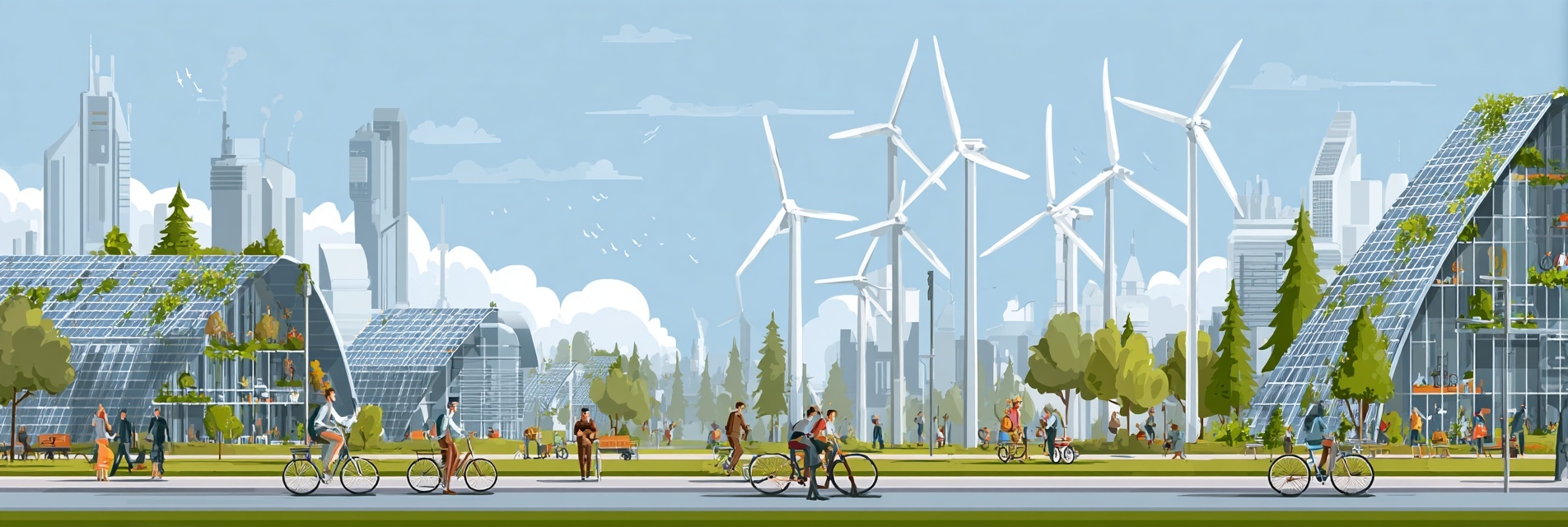
Station Three: Post-Scarcity Transition—Technology for Human Good
Technology—governed democratically and built for liberation—can shrink suffering, reduce required labor, expand knowledge, stabilize communities, and turn scarcity into a managed condition instead of a weapon.
The transition to post-scarcity involves:
- Automation that eliminates drudgery—Machines should do what humans shouldn’t have to. Productivity gains should shorten labor, not intensify exploitation or concentrate wealth.
- Abundant renewable energy—Energy independence reduces geopolitical coercion, fossil tyranny, and ecological collapse. Renewable abundance is the backbone of humane modernity.
- Universal basic services—Guaranteed healthcare, housing, nutrition, transit, communication, and education. Not as charity. As infrastructure.
- Open access to publicly funded knowledge—Research, data, and scholarship produced with public money belong to the public. Paywalls that restrict access to publicly financed work impede scientific progress, education, and democratic participation.
- (Protection for individual creative work—Artists, writers, scholars, and independent thinkers have the right to control, license, and be compensated for their creations. Copyright, fair contracts, and enforceable ownership are essential to prevent exploitation, sustain creative labor, and ensure that cultural production remains viable.)
- Free or near-free essential goods—Mass efficiency lets us provide healthcare, housing, transit, and digital communication at negligible marginal cost—if we choose to design for dignity rather than profit.
- Reduced working hours—When technology multiplies capacity, leisure becomes a right, not a managerial concession. Time is the most fundamental form of wealth.
- Human activity chosen, not coerced—Work becomes meaningful contribution instead of survival under threat.
All of this depends on a crucial understanding: Post-scarcity doesn’t equal infinite consumption. It’s intelligent abundance that respects planetary thresholds.
The point of post-scarcity isn’t to produce everything imaginable. It’s to reduce suffering, expand autonomy, and give people the time and security to build meaningful lives.
Ecology is the real boundary. Technology must serve life, not overwhelm it.
Post-scarcity isn’t about doing more. It’s about doing better, with less harm.
Station Four: Federated Humanism*—A Sustainable Society
“People are no longer obsessed with the accumulation of things. We’ve eliminated hunger, want, the need for possessions…”
“The acquisition of wealth is no longer the driving force in our lives. We work to better ourselves and the rest of humanity.” ~ Jean-Luc Picard (because I’m a popular culturalist)
Remember, I said I wasn’t interested in utopias?
We hope that people will have evolved through the first three stations, but we haven’t lost sight of the fact that they’re people. Greed still exists. Power still exists. Everybody doesn’t love everybody else. Anthropologically speaking, it wasn’t that long ago that we lived in trees, and we’re still trying to get the hang of enlightenment.
Station Four may seem a bit utopia-ish from the perspective of 2025, but again, the goal isn’t perfect, it’s better.
The horizon looks like this:
- Basic needs are universally met—not through charity or contingency, but as a non-negotiable feature of civilization.
- Coercive hierarchies disappear—because their preconditions (scarcity, desperation, privatized power, manufactured inequality) have been dismantled.
- Work becomes voluntary and meaningful—chosen because it contributes, expresses, creates, or helps—not because starvation is the alternative.
- Science and creativity flourish—free from ideological interference or corporate gatekeeping. Knowledge becomes a shared inheritance, not a market product.
- Exploration becomes a shared ethic—scientific, artistic, philosophical, interplanetary. Curiosity stops being a privilege of the few.
- Culture fosters empathy—recognizing vulnerability as the universal condition, not a defect to exploit or shame.
- Technology amplifies dignity—not surveillance, not coercion, not monetization. Tools built to support autonomy and well-being.
This isn’t a prediction. But it’s a direction, and it’s better than the one we have now. I don’t know where we wind up if we steer toward this horizon, but I’ll take my chances.
* We don’t have an actual name for this phase yet. As we get closer, someone will come up with the label. In the meantime, call it Federated Humanism or Distributed Democracy or come up with your own term. In the future, the label won’t matter anymore than it does today.
Notes
1: AI
I have Spinocerebellar Ataxia (Type 6, to be specific), which makes typing extremely difficult. It’s also eroding my ability to speak clearly, which means my facility with dictation software gets worse by the day.
To compensate, I made ample use of AI in developing this series.
- It served me as a research assistant—an uber-Google, if you will—and I used it to fetch specific content.
- I used it to compile, summarize, and organize.
- I asked it to construct preliminary drafts.
- Once I had done extensive revision and rewriting, I used it to smooth and ensure consistency in how section two was written. (It should be easy to detect the difference in tone between it and sections one and three.)
- I employed its thesaurus capabilities in a couple of places.
- Also, proofreading…
- …and image development.
- Specifically, I used ChatGPT, Claude, Gemini, and MidJourney.
2: Sources
I’m not doing anything new here—I’ve drawn bits and pieces from a wide variety of political thinking. I also owe a great debt of thanks to all of my friends and colleagues throughout the years whose insight and goodwill have pointed me toward where I am today. This includes my good friends at the Rogues Pub and my professors and fellow students at Wake Forest University, Iowa State University, and especially in the communication doctoral program at the University of Colorado.
I talk in part I about all the arguments I’ve lost. This is them.
3: More Sources
When I shared a draft of this document with some friends, one colleague who currently lives in France offered a comment that amounted to “[yawn], yeah, so what?” In many ways, he observed, what I have written mirrors the European Union Charter of Fundamental Rights, which has been around since 2000.
If Part II looks like science fiction to you, perhaps that alone is worth reflecting on…
 lullaby pit