
Electoral System, Democratic Integrity, Federal Authority: Freedom & Prosperity Framework pt. 1

A modern electoral system built on parliamentary democracy, proportional representation, and constitutional governance.
1. Parliamentary Democracy
The nation should operate as a parliamentary democracy, in which executive power is drawn from and accountable to a legislature elected by the people.
This model reflects the practice of many successful democracies in Western and Northern Europe, where political authority depends on maintaining the confidence of elected representatives rather than concentrating power in a single executive office.
2. Proportional Representation
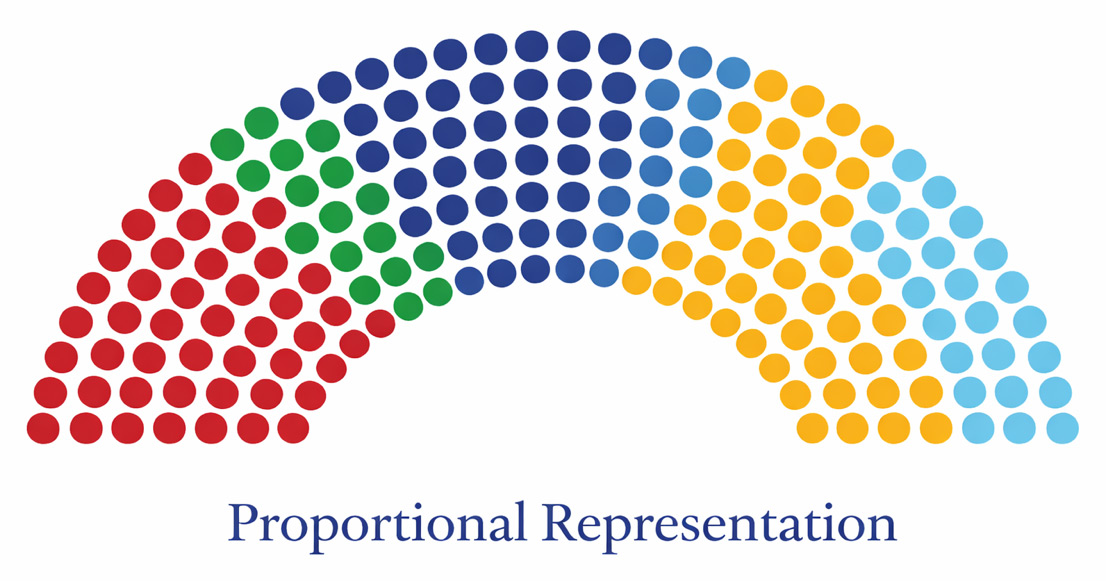
Elections to Parliament should use proportional representation, so that the number of seats each party or electoral list receives closely reflects the share of votes it earns nationwide.
This approach is meant to translate public preference into representation with minimal distortion, ensuring that political power reflects how people actually vote rather than how electoral rules advantage particular outcomes.
3. Electoral Thresholds
Parties or electoral lists receiving at least five percent of the national vote should be represented in Parliament.
Representatives should be chosen by direct vote in a way that preserves proportionality and political pluralism.
4. Equality of the Vote
Representation should be fair, inclusive, and broadly reflective of the electorate as a whole.
Each person’s vote should carry equal weight, and electoral rules should not significantly distort how votes are translated into seats.
5. Public Interest
The electoral system should serve the democratic will and best interests of the people.
It should protect fair and inclusive representation and resist efforts to undermine representative government, without suppressing lawful dissent or political pluralism. Democratic legitimacy rests in majority decision-making constrained by explicitly protected rights, not by institutional structures that entrench minority rule or grant permanent veto power over democratic outcomes.
6. Fair Elections
Elections should be publicly funded and conducted on equal footing, without reliance on private wealth, corporate influence, or donor-driven access.
Electoral rules should translate voter preferences into representation with minimal distortion. No procedural mechanism may be used to negate majority outcomes through obstruction or delay unrelated to the protection of fundamental rights or constitutional order.
7. Federal Sovereignty
The nation should function as a unified federal system in which ultimate political authority rests with the national constitution and government.
States should exist to administer and implement law at regional and local levels, not to override, obstruct, or selectively apply national law. Federal law should operate uniformly, and basic political rights should not depend on where a person lives.
When state or local authorities act in ways that undermine equal participation, deny protected rights, or impair the consistent application of national law, federal authority should intervene to restore those rights and ensure equal treatment.
8. Constitutional Court
A constitutional court should exist to interpret the constitution and to determine whether laws or government actions are consistent with it.
The court should be composed of professionally qualified judges selected through an independent, non-partisan process and confirmed by the legislature. Judges should serve a single, fixed term and be removable only for serious misconduct or incapacity. Appointments must not be controlled by any single political actor or blocked through procedural delay.
The court’s role is to resolve constitutional questions and protect explicitly protected rights, not to govern directly or substitute judicial preference for democratic judgment.
Judicial review must be conducted decisively. Courts must not exercise de facto veto power through inaction, indefinite delay, or procedural avoidance. Constitutional adjudication should constrain the misuse of power, not paralyze democratic governance.
9. Legislative Override
Courts should not be the final arbiters of all political questions.
In matters that do not implicate explicitly protected fundamental rights, the legislature may, by a strong and sustained democratic consensus, reaffirm a law even after a court has ruled it unconstitutional. Such decisions must reflect broad agreement over time rather than a momentary majority.
Judicial review should focus on concrete harms to protected rights, not abstract policy disagreements. Questions of economic regulation, administrative design, or general public policy should ordinarily remain within the democratic domain unless they directly infringe an explicitly protected right.
Procedural rules must not operate to grant minority factions permanent or costless veto power over democratic governance. Democratic disagreement with courts should be visible, accountable, and revisitable, not indefinite or obstructive.
10. Constitutional Limits on Private Power
Private entities should be subject to constitutional limits when their size, market power, or institutional role gives them the practical ability to control, exclude, or materially impair the rights, dignity, or democratic participation of others.
When corporations or other private actors exercise power comparable to public authority—by shaping access to work, housing, information, essential services, or political participation—core constitutional protections must apply to prevent domination, coercion, or abuse. Such limits should be applied carefully and only to the extent necessary to protect rights, dignity, and democratic participation.
All constitutional principles should be interpreted with the same aim: preserving democratic self-government, protecting human dignity, and preventing the concentration of power—public or private—from overriding equal political participation.
11. Professional Adjudication and Democratic Legitimacy
Criminal justice should be administered by people who are trained, independent, and accountable to the law rather than by temporary, untrained participants asked to make irreversible decisions.
Serious criminal cases should be decided by professional jurors serving as public officers for fixed, non-renewable terms. These jurors should be selected through an independent process, trained in evaluating evidence and legal procedure, and insulated from political pressure. Their role is to apply the law consistently and competently, not to represent public opinion in the moment.
At the same time, justice must remain publicly legitimate. Democratic participation should be preserved through non-decisional forms of public involvement—such as open proceedings, civic review, community and victim impact processes, and other mechanisms that promote transparency, understanding, and trust without transferring adjudicative power.
The purpose of this model is not to exclude the public from justice, but to separate democratic oversight from judicial decision-making, so that verdicts are both professionally sound and publicly accountable.
Summary
This framework presents a comprehensive model for modern democratic governance centered on electoral integrity, representative legitimacy, and constitutional balance. It outlines a parliamentary system in which executive authority derives from the elected legislature, ensuring continuous democratic accountability. Proportional representation aligns political power with voter preference, promoting pluralism while preventing systemic distortion of outcomes. Equal voting power, publicly funded elections, and uniform federal authority safeguard fair participation across regions and populations. Independent constitutional adjudication protects explicitly guaranteed rights while preserving democratic decision-making in ordinary policy matters. Together, these institutional designs aim to prevent the concentration of power, strengthen public trust, and secure a durable system of self-government grounded in accountability, equality, and the rule of law.
 lullaby pit