
Speech Isn’t Power. Never Was, Never Will Be.
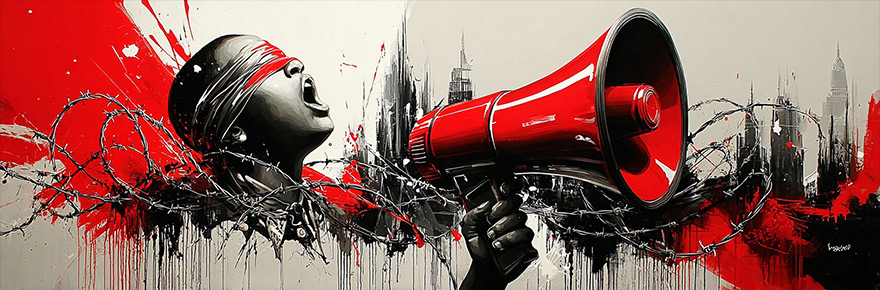
The First Amendment is the cleverest tool for control in history.
One of the most enduring political fictions in American life is the idea that free speech equals political power — that the ability to speak, print, assemble, and petition means you have meaningful influence.
It’s a foundational myth, and it was by design.
The Founders didn’t create a democracy for everyone. They created a system for themselves: propertied, white, male elites. They feared direct democracy. They feared the poor. And they absolutely never imagined political power being shared with women, indigenous people, or the enslaved. Many, including Jefferson, viewed true mass participation not as a goal, but as a threat.
So they built a structure that allowed for controlled expression but limited actual access to power. The First Amendment guaranteed free speech and a free press, yes — but within a system engineered to keep real power in the hands of the enlightened few.
The brilliance of this design was how effectively it fostered the illusion of participation. People could argue, publish, assemble. That activity felt like ownership, especially compared to 18th-century Europe.
You could speak, but not decide.
Jefferson’s role is especially revealing. He spoke eloquently about liberty and the will of the people. But he enslaved hundreds, routinely raped female slaves, believed in natural hierarchies, and saw participatory government as something to be tightly managed. He supported free speech not to empower the masses, but to stabilize elite rule. If people felt heard, they were less likely to rebel.
And it worked. It works better now than it did then. The American public was granted just enough participation to feel invested — what we’d now call “buy-in.” There was no need to take up arms or storm government buildings. You had a voice. You were told you were the system.
But speech isn’t power. It’s proximity to power. It has long served as a release valve — something to keep the population engaged, expressive … and largely inert. The Founders didn’t make a mistake. They weren’t naïve. They built a system that allowed for expression, but not disruption.
That system still holds. We have more channels for expression than ever — social media, 24/7 news, endless petitions, and protests — but decisions remain tightly held by institutions, donors, courts, and corporations. Talking feels like doing. And that’s the point. The performance of engagement replaces the practice of power.
The problem isn’t that people don’t care. The problem is that the structure was never designed to give them actual control. It was built to manage them.
Speech without power. Participation without control.
And now that system is being repurposed by an autocrat posing as a populist, leading a movement that is probably the Founders’ worst nightmare come to life.
He exploits the original design to dismantle what remains of its safeguards. He uses speech not to represent the people, but to erode the institutions intended to check power. The illusion still holds. You see it every week on social media: disbelief, outrage, confusion that somehow still clings to our core assumptions about “democracy.”
But the intent has shifted. What began as a structure to contain the masses and protect an 18th-century agrarian oligarchy is now a platform for consolidating rule under a 21st-century digital “information” oligarchy.
Ironic, yes?
Speech isn’t action. It never was.
The system survives because we mistake the two.
 lullaby pit