What is Thought Leadership, Really?

Hint: It’s not entry-level. (There’s even a chart!)
The term thought leadership has been stretched thin, overused, misused, and watered down to the point where it barely means anything.
For instance, I routinely see the term slapped onto job ads—even very junior ones—where it simply doesn’t belong. You might find it right between “blogs” and “SEO,” as if thought leadership is a channel. You know: LinkedIn posts, newsletters, and thought leaderships.
The trend is bad enough that JobScan dinged me for using it once because it was a buzzword.
I hate to be Grandpa Simpson shaking his cane at the clouds, but thought leadership isn’t a channel. It’s a strategic function, and treating it like it’s another entry-level content bucket muddles our thinking and diminishes its value.
Less About the Company, More About the Industry
Here’s my view: thought leadership is about climbing levels of influence.
- Company performance—Prove the company can deliver. Sell products, drive revenue.
- Industry standing—Translate success into industry stature. Become a recognized leader among peers.
- Public authority—Step beyond the industry. Influence how your field intersects with society at large.
Nothing controversial here. Businesses start by selling stuff. If they’re successful they become industry players. If they’re really good, they gain enough heft to shape conversations beyond their industry—not as experts on everything, but as recognized authorities on how their sector intersects society and the economy.
Establish the company → lead the industry → shape the conversation beyond it.
That’s thought leadership. Not another channel, but the pinnacle of a progression of credibility and influence.
I promised you a chart. Let’s do something revolutionary—a pyramid.
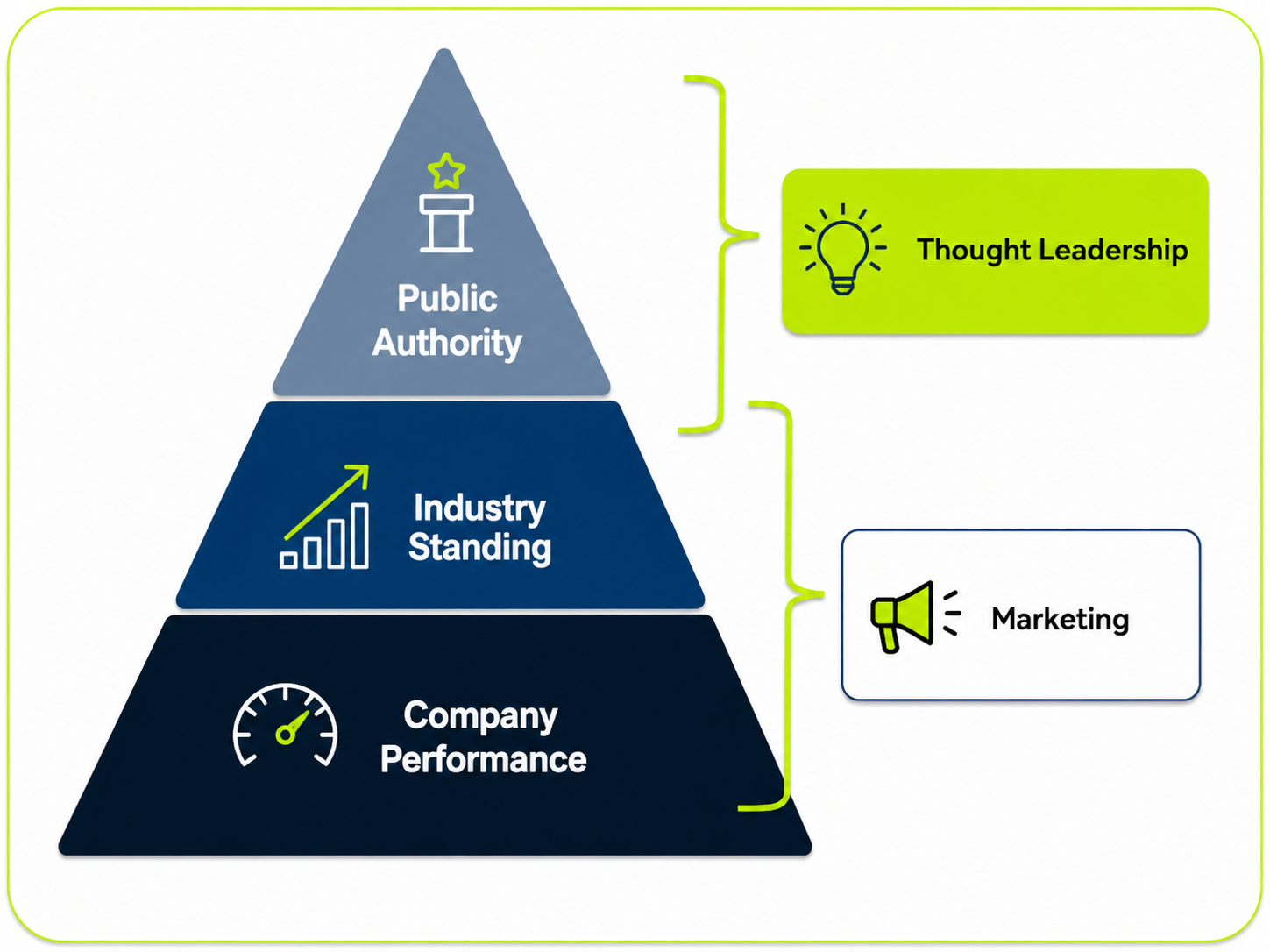
On the right we see that traditional “marketing” is employed in the bottom two tiers of the pyramid: webpage copy, blogs, social, events, PR, and a host of other channels support the business’s goal of rising to the top of its industry.
The graphic also indicates that thought leadership picks up toward the top of the second tier, and it continues to the top. As companies demonstrate greater success within an industry, they naturally accrue greater credibility when discussing issues facing the industry. At a point, success within the industry confers the authority to speak on the industry.
A Quick Caveat
Various marketing channels can be employed anywhere in the pyramid, although where they’re most effective varies. At the bottom, web pages, solution briefs, and white papers might prove most useful at winning the interest of potential customers. Further up the ladder, the organization might use bylines and effort to place executives as event speakers to establish and leverage thought leadership status. YMMV. And yes, despite the big green box with the boldface label, TL is certainly part of marketing.
Now, let’s look at a hypothetical case.
ACME Analytics
ACME Analytics is a highly rated cybersecurity managed detection and response (MDR) provider leveraging machine learning-enhanced detection and AI-driven security orchestration. Their SaaS platform serves enterprise clients with industry-leading threat detection and significantly reduced false positives, defending against advanced persistent threats and nation-state attacks through continuous AI learning.
Company Performance
To build visibility, ACME leans on marketing techniques aimed at showing competence and trustworthiness. Its website emphasizes service tiers, response times, and pricing clarity. White papers and solution briefs explain how MDR differs from basic monitoring, while customer case studies highlight concrete wins. The approach is practical and deliberate—prove expertise, educate prospects, and position ACME as a solid, financially sound option in the crowded MDR market.
Tried and true. The founders have a good idea, they develop great technology to solve a known problem, and spend their early years nose-to-grindstone. They work hard to build credibility at the technical level and to develop success stories they can use to grow.
Industry Standing
By its seventh year, ACME has developed a growing roster of enterprise clients and established a solid track record of rapid response. The company begins to engage and influence industry conversations. Research reports and benchmark studies position ACME as a reference point for enterprise security operations. Analysts begin ranking it alongside established providers, and company leaders increasingly feature at major security conferences, offering case-driven insights on MDR best practices.
The first tier was about proving that you know what you’re doing. The second is a war zone. The industry is crowded with competitors, and many of them are very good at what they do. Marketers need to bring the full tool kit to bear because now they have to demonstrate, to a skeptical audience, that they’re better than the other guy. Better on tech. Better on service. And better on ROI.
There’s another problem here. You’re up against competitors who were proving their excellence while you were still tinkering around in the garage. They have more money, better resources, stronger relationships, and greater market visibility.
Even being the best might not be enough. I once worked with a technology company that was tops in its industry. Literally, the most important analyst in the sector ranked them number one.
Unfortunately, they were up against companies that had been around for years. So while my employers were exceptional on product and service, their market presence was disturbingly small.
So, as many readers already know, tier two is a bear.
Public Authority
In keynote speeches, an appearance on CNBC, and high-profile testimony before the Senate Commerce, Science, and Transportation Committee, ACME’s CEO argues that the nation’s digital defenses remain dangerously fragile because of the fragmented nature of Internet infrastructure. The company publishes a series of white papers calling for a “new Internet”—one grounded in stronger cryptography, quantum-resilient security, and decentralized protections against failure.
Deep in the heart of thought leadership, the established company seeks to boost its profile (and market success) by leading. Here’s where our industry is, here’s where it’s going, and by the way, the industry finds itself on the front line of a battle that threatens the well-being of the country.
Clarity
This is why thought leadership isn’t an entry-level box to tick. The credibility and expertise required to shape big conversations is earned through years in the trenches.
Our industry loves it some buzzwords, but it’s always okay to think and speak clearly.
 lullaby pit