AI Gets One Right?
Technology solves an important problem.
I want to show you something.
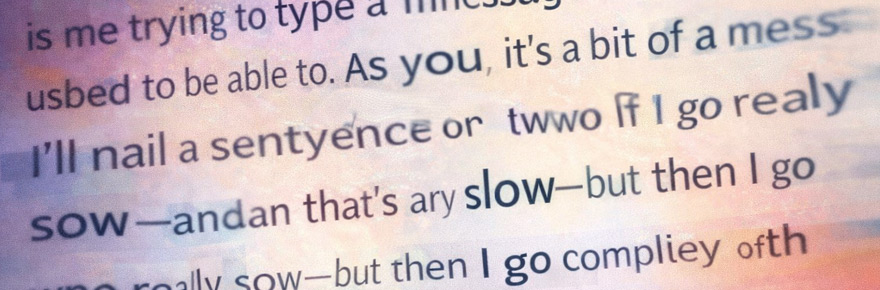
Whatg I want to do now is write a meesage to iklustrte something. I don’tt talka btou the atazia any more than I hae ro, but it eodes fine motor skills. This is me trying pt ty[pe a message the way I used to be qab;e to. As you can see, it’s a bit of a mess. I’ll nail a sentyece or tywo if I go really sow – and that’s VERY slow – but then I go compleely off the rails wth my fingers flaiuling like one of those wind sock things they have at us4ed car lota. So I don’t ty[pe much. I us4 ma’c’s dictat0on funtijm n, whih isn’t great but it’s the bet I can do. Philips has something thT’S A little bette, butt not $500 a ytear better. So iuf you noice more mistakex from me when I se4nd a messages that’s why. I’m wreztluing wth dictation. One other issue: the ataia also destroys your speech abilities. I6t’s embartrzssinh how badly I slur sioetiumes and I can’t make my mouth form some sounds. This has a predictable effect of the dictation’s abiliy to understand e.
Here’s what I was trying to say.
What I want to do now is write a message to illustrate something. I don’t talk about the ataxia any more than I have to, but it erodes fine motor skills. This is me trying to type a message the way I used to be able to. As you can see, it’s a bit of a mess. I’ll nail a sentence or two if I go really slow – and that’s a very slow – but then I go completely off the rails with my fingers flailing like one of those windsock things you see at a used car lot. So I don’t type much. I use Mac’s dictation function, which isn’t great but it’s the best I can do. Philips has something that’s a little better but not $500 a year better. So if you notice more mistakes from me when I send a message, that’s why. I’m wrestling with the dictation. One other issue: ataxia also destroys my speech abilities. It’s embarrassing how badly I slur sometimes and I can’t make my mouth form certain sounds. This has a predicable effect on the dictation’s ability to understand me.
It took me nearly five minutes to produce the previous 188-word paragraph.
Some of you know that I have spinocerebellar ataxia. One of its fun effects is that it erodes motor skills, like the ability to control your fingers, which is essential to typing.
I’ve been trying for a couple of years to find dictation software that would allow me to speak what I want to type. Up until now the best thing I’ve found is actually Apple’s dictation software, which is native to the Mac and iPhone. Here’s the five-second review: just because something is the best, that doesn’t mean it’s good. And as I note above, the product from Philips was better, but not worth the money.
Since technology innovation is screaming forward at a white-knuckle pace, I do another search every three or four months to see if something new has hit the market.
Yesterday, jackpot.
My AI buddies all pointed me toward something called Wispr Flow.
I asked Claude to distill their marketing pitch to one paragraph:
Wispr Flow doesn’t just transcribe your speech, it understands context and automatically turns your natural, messy spoken words into clean, formatted text ready to send, right inside whatever app you’re already using. Works across Mac, Windows, iPhone, and Android, supports 100+ languages, learns your personal vocabulary and style over time, and the company claims the median user eventually does 72% of their computer input by voice instead of keyboard. The promise is that speaking to your computer finally becomes as effortless as talking to a friend—at $12-15 a month.
Fuck, it’s good. Seriously good. I’m using it to compose this post and spending almost zero time going back to clean things up. It even learns when I make a fix.
I’ve been screaming for this tool for at least two or three years. Hell yes I can swing $15/month.
Yes, AI is guilty of most of the things it’s been charged with:
- Job displacement—automation eliminating livelihoods without adequate safety nets
- Wealth concentration—AI profits flowing to a tiny elite
- Surveillance and privacy—enabling unprecedented monitoring of populations
- Bias and discrimination—encoding and scaling existing social inequities
- Misinformation—deepfakes and synthetic content undermining truth
- Manipulation—AI-powered targeting exploiting psychological vulnerabilities
- Autonomy in warfare—lethal autonomous weapons with no human judgment
- Environmental cost—enormous energy and water consumption
- Existential risk—advanced AI potentially acting against human interests
- Accountability gaps—no clear responsibility when AI causes harm
And of course:
- Theft of creative work—AI systems trained on vast amounts of copyrighted text, images, music, and code scraped without consent, compensation, or credit to the original creators, effectively profiting from artists’, writers’, and musicians’ life’s work while undermining their ability to make a living
This, though, is a case of the tech being used to improve people’s lives without, as far as I can tell, making things markedly worse elsewhere. (Although they could be guilty of the enviro impact issue?)
I hope Wispr’s execs don’t turn out to be a bunch of sociopathic Silicon Valley techbros. For the moment they look like an example of how technology innovation and development should work in a modern society.
Right now, though, I’m reveling in the fact that I’m a little less disabled than I was a day ago.

